-
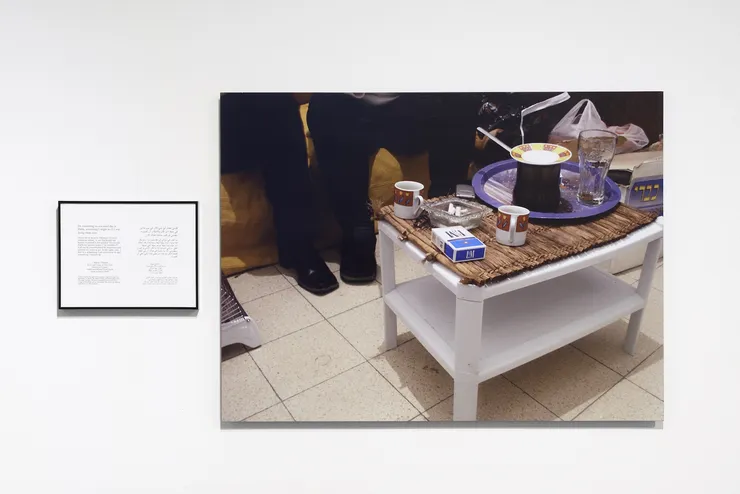
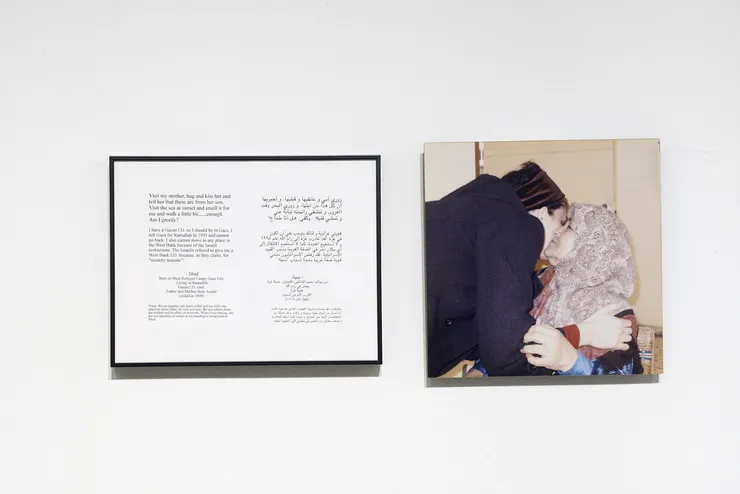
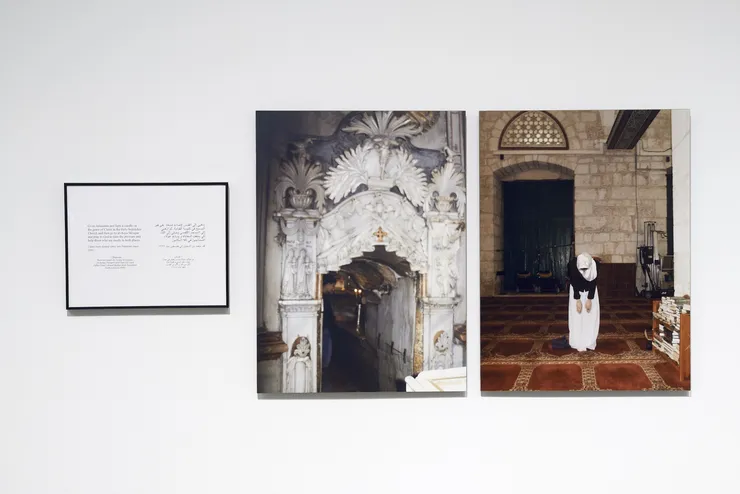
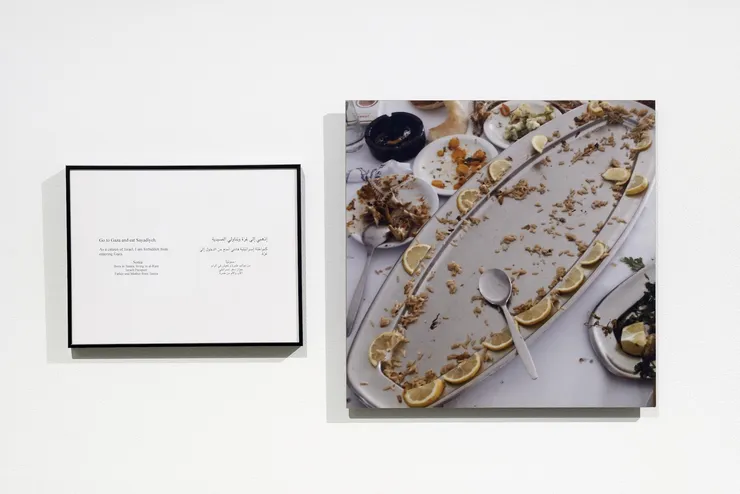
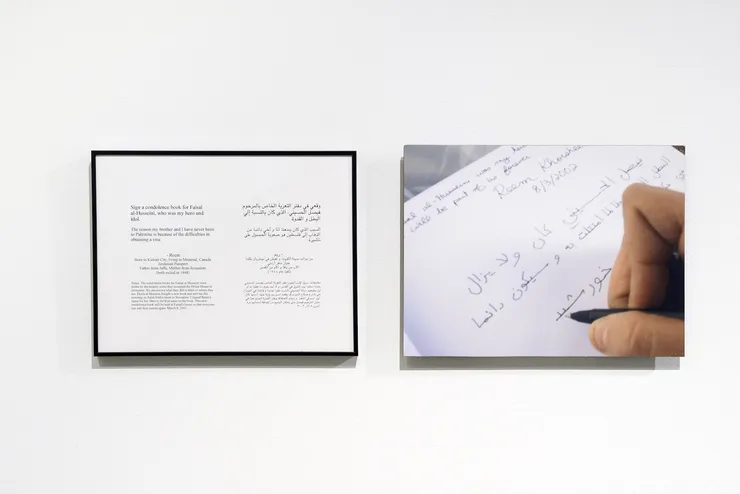
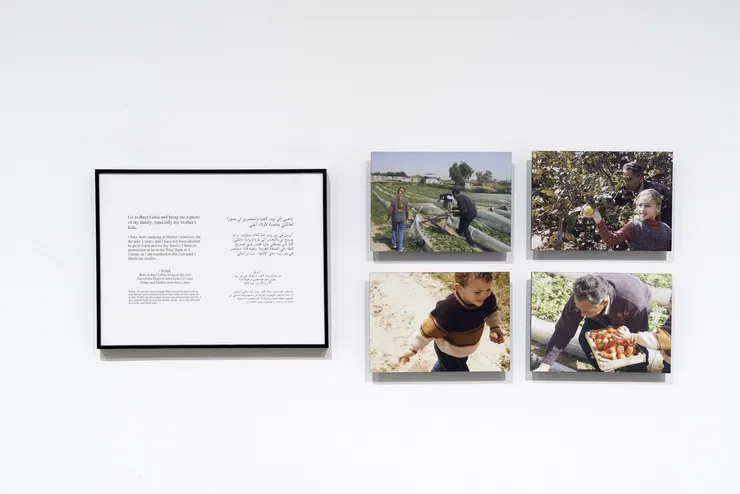
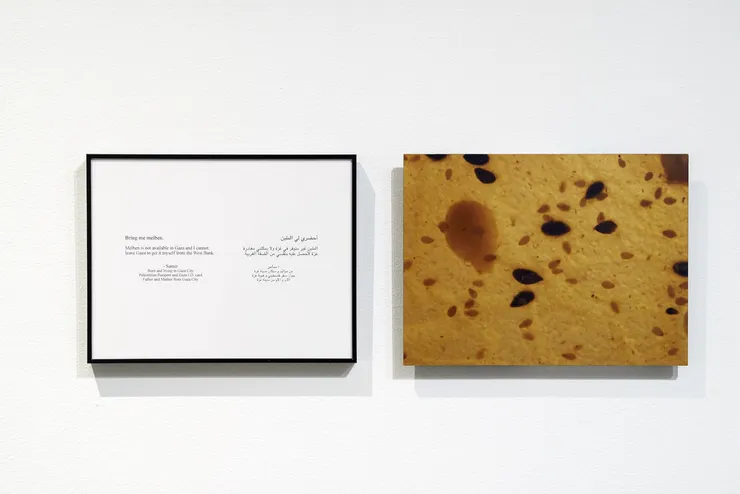
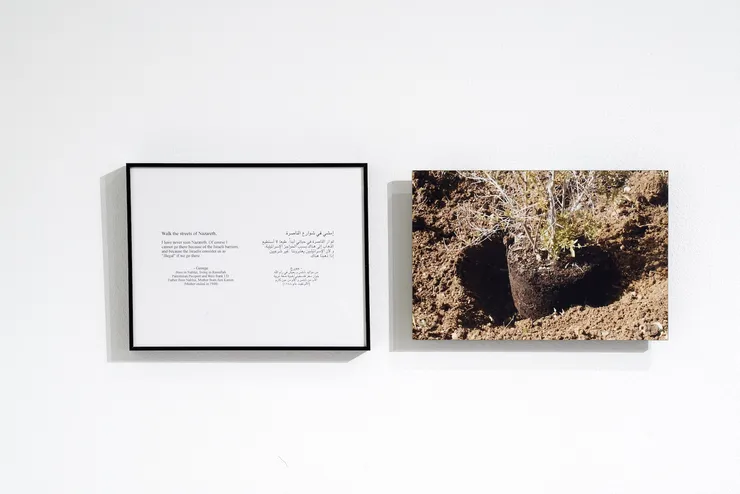
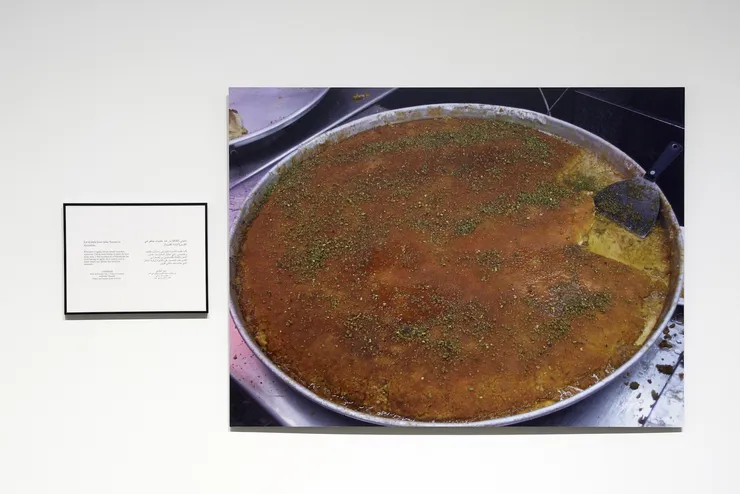
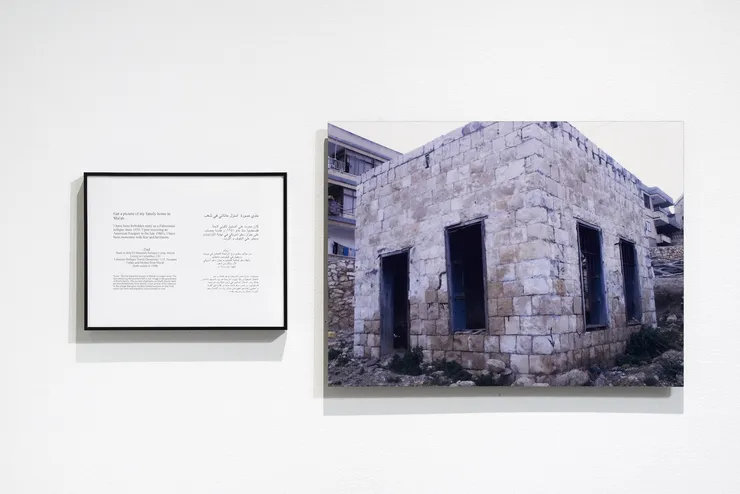
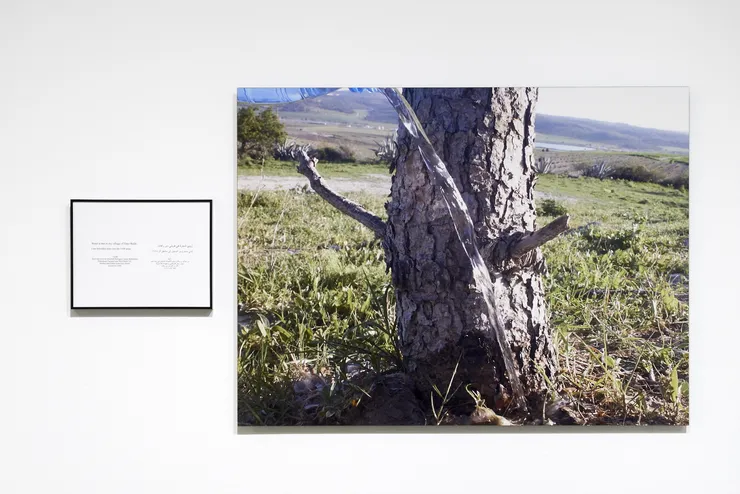
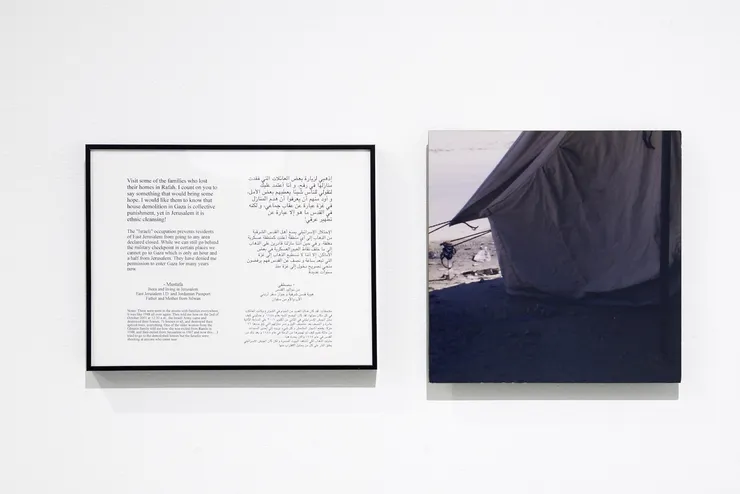
Where We Come From, Emily Jacir’s debut solo at the gallery and in India, brings together a seminal body of work. Through rigorous historical and archival research, Jacir’s layered and resonant body of work is rooted in gathering, community, and in social affiliations. As poetic as it is political and biographical, her work investigates silenced histories, exchange, translation, transformation, and resistance.
-

-
-
-
-
Artist statement
Where We Come From is based on my “freedom of movement” as a Palestinian with an American passport, a document which allows me this basic human right. I utilized my passport to access Palestine for Palestinians who are prohibited entry into their own homeland and/or who are restricted movement within it. The question we are always asked at the borders: “Did someone give you something to carry?” was also an inspiration for this piece.This piece comes out of my own personal experience of the constant back and forth between Palestine and whatever country I happen to be residing in at the moment. My parents themselves do not have the access I have to our own country. They cannot leave the boundaries of Bethlehem because their I.D. cards place them there. Each time we made our way back home in the 70’s, 80’s, and 90’s, we witnessed the unrelenting proliferation of settlements, checkpoints/borders, and the calculated fragmentation of our people and our lands into smaller and smaller spaces. Israel has divided us into unnatural fragments based on our identity cards such as East Jerusalemites, West Bankers, Gazans, Israelis, Jordanians, Americans, and so forth.Israel has implemented some of the most draconian and violent military tactics in history to prevent Palestinians from entry into their own homeland as well as the ability to move freely within it. No Palestinian can move freely within the West Bank or Gaza. Measures such as checkpoint/borders, barbed wire, tanks, and soldiers with M-16’s have encircled every town and village. Palestinians are killed trying to cross these borders. Those that do have the ability to move are subjected to the worst forms of humiliation at every crossing in an effort to discourage people from entering or moving around the country. These measures have been implemented and designed to fragment and destroy the fabric of our entire people. The situation is now so extreme that going to Jerusalem is as impossible a dream for a Palestinian in Syria as for a Palestinian living 8 kilometers away in Beit Jalla.Emily JacirMarch 2002It is now May 2004 and the situation has worsened. I can no longer move freely through the borders with my American passport. I can not make the project “Where We Come From” today. I am no longer allowed to enter Gaza, and certain Palestinian towns in the West Bank. Israel is relentlessly moving forward in the construction of the Apartheid Wall which began in the spring of 2002. Palestinians with foreign passports are increasingly being denied entry into the country by Israel at all border crossings and are being forced to immigrate. Israel has decided that “freedom of movement” is no longer a right for American passport holders and has created measures to ensure this. -
-
-
‘Do Something on a Normal Day’: Emily Jacir’s Where We Come From
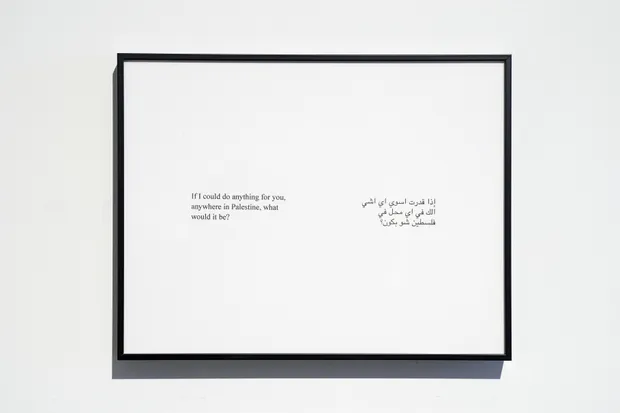
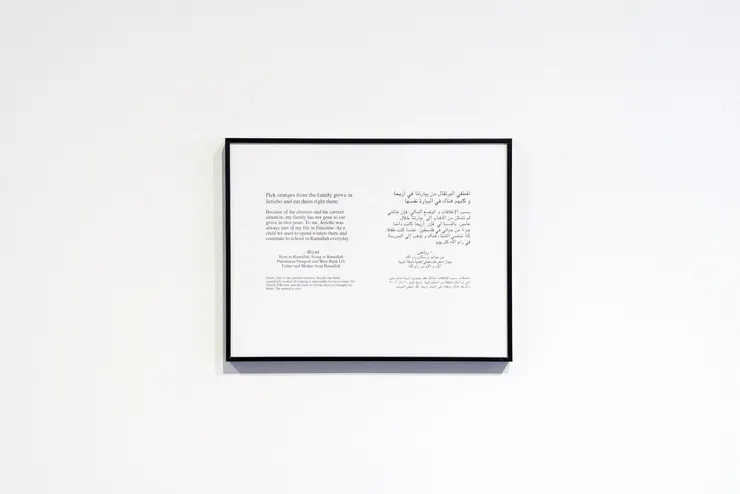
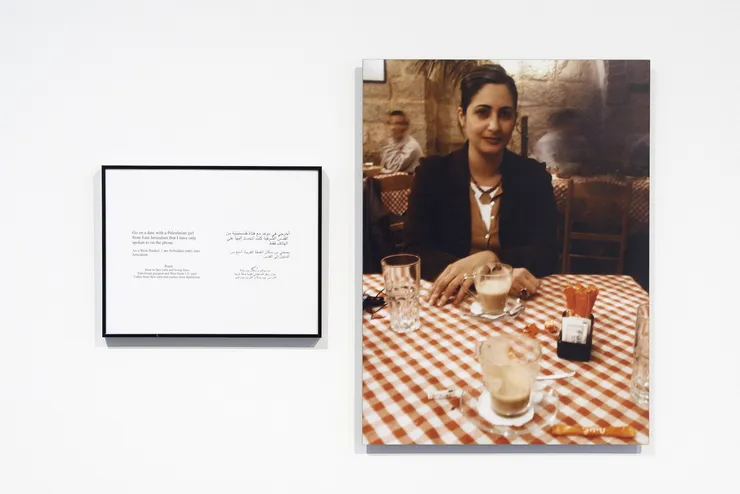
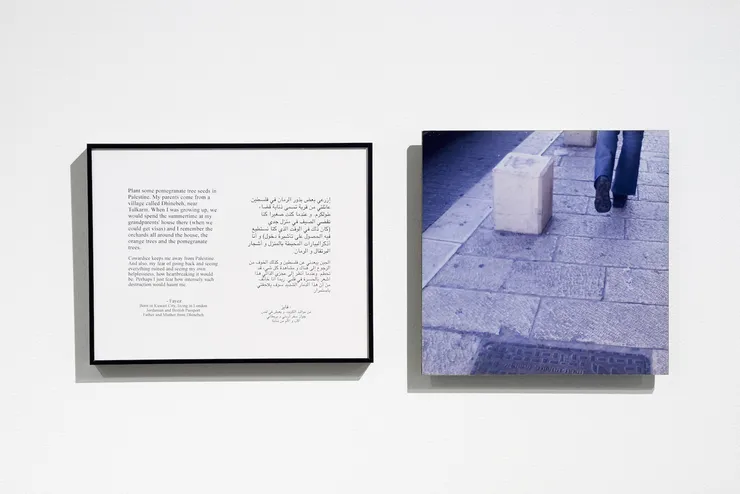
Declan LongAccording to Google Maps, the distance between Jerusalem and Bethlehem is 5.7 miles. The predicted travel time — based on Google’s algorithmic data- crunching — is around thirty minutes. For such a short drive, one that might be unremarkable in many other cases, the expected speed seems slow: painfully so. Depending on who you are, of course, the pace of your potential progress could quicken, or become significantly slower still. This is a busy, main thoroughfare — the Hebron Road — and like so many routes across this intricately fragmented and strategically segmented geography, it is interrupted by checkpoints: barriers where the meaning of ‘who you are’ is, in part, determined by where you’re from, or even, indeed, when you’re from. Possibilities for movement and passage depend on what type of passport or ID card you carry — and which version of these you hold in your constant possession is, unavoidably, an outcome of a complex, cruel history, a continuing effect of oppressive present-day politics, and, fundamentally, a divisive product of the ways that those in power have placed you — the ways they have located and limited you — as a citizen or subject.Here is a dispiriting, everyday example, one of many documented by Emily Jacir over fifteen years ago in Where We Come From — and one of a million micro-incidents that might be easily overlooked amongst the multitude of frustrations, restrictions, and humiliations suffered by Palestinians on a routine basis. In 2002, the 5.7 miles between Jerusalem and Bethlehem could not be travelled by a man called Munir, his humble wish being to visit his mother’s grave on the day of her birthday. Born in Jerusalem but living in Bethlehem, Munir had sought to undertake a modest personal pilgrimage: paying tribute to his deceased mother, praying and laying flowers at her final place of rest. By any reasonable measure, this decent, apolitical act should be no big deal. As the holder of a Palestinian passport and a West Bank ID (and as the son of parents exiled from Jerusalem in the Nakba of 1948), Munir was, however, subject to the capricious constraints of state power and denied the right to cross from one neighbouring locality to another. On this occasion — as with, no doubt, so many others over subsequent years — Munir’s honourable family commitment could not be fulfilled. But even if, in such cases, certain borders can be crossed — official entry permits approved — the predicament for Palestinians wishing to make such standard, dutiful journeys — going from here to there and back again within the familiar settings of quotidian life — is arduously intolerable.The practical impact of an anticipated checkpoint might change; the probable duration of a planned journey might be impossible to judge. And as John Berger has written, the effect of this on daily life is relentless. As soon as somebody one morning says to himself ‘I’ll go and see — ’ he has to stop short and check how many crossings of barriers the ‘outing’ is likely to involve. The space of the simplest everyday decisions is hobbled, with its foreleg tethered to its hind leg.[1]Time too, Berger said, becomes ‘hobbled.’ Movement is fitfully impeded, disrupted with maddening unpredictability. Trips across minor distances become drawn-out expeditions: “nobody knows how long it will take this morning to get to work, to go and see Mother, to attend a class, to consult the doctor, nor, having done these things, how long it will take to get back home.” Any sure sense of “temporal and spatial continuity” is destroyed. And if they are maddening, these conditions must be deadening, too: so much precious time given over to going nowhere. “For the most part,” Edward Said once observed, “Palestinians wait: wait to get a permit, wait to get their papers stamped, wait to cross a line, wait to get a visa. Eons of wasted time, gone without a trace.”[2] Where We Come From (2001–03) is, amongst much else, a double-edged account of movement and stasis, a richly plural record of both relative freedom and severely imposed confinement. Across a series of small, evocative images and succinct accompanying statements, we are given glimpses of thirty Palestinian lives (a selection from the considerable number of people Jacir actually communicated with), each one acknowledging a different type of daily, highly localised limitation or traumatic, long-term separation. As the holder of an American passport, Emily Jacir had, at that time, been able to travel with more certainty and regularity than many fellow Palestinians: This identifying document afforded her the flexibility to come and go both within and beyond her homeland. (It’s worth emphasizing, of course, that such an entitlement should not be exceptional: It is a fundamental condition of individual liberty, enshrined in the UN’s Universal Declaration of Human Rights.) Jacir’s US passport had empowered her to proceed past checkpoints, to cross borders with a degree of confidence. Movement was possible, if not straightforward — as no movement from place to place in Palestine is ever allowed to be. But Jacir’s travel credentials were valuable in enacting another, more expanded and collective kind of access. Put to new use in the conception and realisation of Where We Come From — a work comprising thirty-two photographs, thirty framed texts, and a single video — the passport provided, as Jacir has noted, a way to “access Palestine for Palestinians.” Jacir’s conceit was to go to locations on behalf of others, to carry with her the requests, messages, prayers, desires, memories (and much more besides) of those prevented from making it to particular places themselves. Where We Come From thus captures a sequence of excursions, experiences, meetings, and observations; it reports back from trips that others could not take, because they were either prohibited from entering the occupied Palestinian territories, or denied the everyday licence to move freely inside these controlled, carved-up, highly militarised landscapes. (In recounting these conditions, the past tense is important, but not because this period has been left behind. Since the early 2000s, there has been substantial change, but zero improvement. Holders of American and European passports do not, now, have their once-available ‘freedom of movement’; and longer, higher walls now divide and isolate communities with insistently intensified force.)So, then, Where We Come From introduces us to Munir from Bethlehem, who asks Jacir to visit his mother’s grave. We meet Hana who lives in Houston, Texas, and who has never been to Palestine — her wish being that Jacir might “go to Haifa and play soccer with the first Palestinian boy you see.” We meet Rizek, a student at Birzeit University in the West Bank; his hometown is Bayt Lahia, around fifty miles away in Gaza, and having left, he can’t return. After three years away — maybe the first three years of forever — his hope is that Jacir might call on his family and perhaps bring back a picture of his brother’s kids. Some such requests strike a poignant note. (From a man called Jihad, living in Ramallah: “Visit my mother, hug and kiss her and tell her that these are from her son. Visit the sea at sunset and smell it for me and walk a little bit.”) Others speak to the absurdity of life under extreme, fenced-in conditions. (From Mahmoud, living in Kufar Aqab: “Go to the Israeli post office in Jerusalem and pay my phone bill. I live in Area C . . . under full Israeli control, so my phone service is Israeli...I am forbidden from going to Jerusalem, so I am always looking for someone to go and pay my phone bill.”) Others again seek expressions of untroubled, uncomplicated existence, remembered or imagined: Marie Therese in New York asks Jacir to “Do something on a normal day in Haifa,” making us wonder, surely, what a word like ‘normal’ might yet mean. The stories recorded in Where We Come From — judiciously distilled as brief, explanatory notes and up-close, in-the-moment snapshots — are both divergent and consistent in their evocations of personal history and political reality. We see Palestine from multiple, plural perspectives while gaining a strong, stirring sense of shared desire, shared disappointment, shared despair. From one angle, the collated ‘plurality’ of viewpoints has, perhaps, a disturbing dimension: Where We Come From demonstrates how extensively — and purposefully — the Palestinian people have been separated into diversely located and dislocated clusters; defined, segregated, and dispersed as disconnected groups. (Some are labelled, and locked into a way of life, by the colour-coded IDs that denote residency in Gaza, the West Bank, or Jerusalem; others have their identity — and liberty — partially determined by ownership of Israeli, Jordanian, or American passports.) Yet the title and content of Where We Come From declare resistance to these fixed, enforced designations. Jacir’s work calls an anxious, urgent ‘we’ into provisional existence, just as, at the same time, it concentrates our attention on the diverse, under-represented details of individual Palestinian experience.1. John Berger, “Stones (Palestine, June 2003),” in Landscapes: John Berger on Art, ed. Tom Overton (London: Verso, 2016), 232.2. Edward Said, Wherever I Am: Yael Bartana, Emily Jacir, Lee Miller (Oxford: Modern Art Oxford, 2003), 35 (first published as “Emily Jacir” in Grand Street 72, Autumn 2003).— Declan Long, originally written for 𝘌𝘮𝘪𝘭𝘺 𝘑𝘢𝘤𝘪𝘳: 𝘞𝘩𝘦𝘳𝘦 𝘞𝘦 𝘊𝘰𝘮𝘦 𝘍𝘳𝘰𝘮 (Hanover, New Hampshire: Jaffe-Friede Gallery, Dartmouth College, 2019) -
-
-
Emily Jacir is an artist and educator active in the Mediterranean region. Her work focuses on themes of transformation, translation, resistance, and the exploration of silenced historical narratives. She uses a wide range of media and methodologies including film, video, photography, sculpture, installation, performance and archival research to investigate personal and collective movement through public space and its implications for the physical and social experience of transmediterranean space and time. For the last twenty years, she has been working in southern Italy, primarily in Salento but also in Basilicata and Sicily. Her most recent work, We Ate the Wind, features a large cinematic installation that combines new and archival material, addressing questions of visibility and invisibility, proximity and distance, hospitality and exclusion, exploring specific migration policies and their consequences on individuals and communities. Drawing on rituals such as dances, processions and games, the artist charts the way space, collectivity and memories are claimed.Emily Jacir has received significant recognition and awards, including: Golden Lion, 52nd Venice Biennale (2007); Prince Claus Award, The Hague (2007); Hugo Boss Prize, Guggenheim Museum (2008); Alpert Award, Herb Alpert Foundation (2011); Rome Prize Fellowship — Andrew W. Mellon Foundation, American Academy in Rome, Rome (2015); Arts and Letters Awards in Art — American Academy of Arts and Letters, New York (2023); and an honorary doctorate — NCAD, Dublin. Her solo exhibitions include those at: OTO SOUND MUSEUM (2024); MCBA — Musée cantonal des Beaux-Arts, Lausanne (2023); Bozar, Brussels (2023); Space 204, Nashville (2022); Galleria Peola Simondi, Turin (2021, 2013, 2010); Irish Museum of Modern Art, Dublin (2016–17); Whitechapel Gallery, London (2015); Darat al Funun, Amman (2014–2015); Beirut Art Center (2010); Guggenheim Museum, New York (2009). Her group exhibitions include: Biennale of Sydney (2026); Malta Biennale (2026); Mathaf: Arab Museum of Modern Art, Doha (2026); Fondazione Merz (2025); 32 Bienal de Pontevedra (2025); Moderna Museet, Stoccolma (2025); 60th Venice Biennale — Collateral Event, Venice (2024); MoMA, New York (2023); Manifesta 14, Prishtina (2022); Hamburger Bahnhof – Museum für Gegenwart, Berlin (2021); Fondazione Merz, Turin (2020); Witte de With Center for Contemporary Art, Rotterdam (2018); documenta, Kassel (2017, 2012), among others. Jacir is the founder of Dar Yusuf Nasri Jacir for Art and Research in Bethlehem.
Select readings:Frieze: Influences: Emily JacirStudio international: Emily Jacir – interviewThe New York Times: Border Crossings Between Art and LifeThe New York Times: Material for a Palestinian’s Life and DeathBidoun: Emily Jacir, DispatchHyperallergic: Silence Is Enough: On Emily Jacir
Emily Jacir | Where We Come From
Current viewing_room