-
-
Experimenter presents The cage broke, and I found the horizon, Rathin Barman’s solo at Experimenter Outpost at Alipore Museum, Kolkata. The exhibition brings together a new body of work, spanning sculptures and drawings, seen together for the first time in the city.
The title of the exhibition alludes to the duality of confinement and liberation, while also situating the works within the history of one of Asia’s largest prisons, the erstwhile Alipore Jail, now the Alipore Museum. This site housed many prominent Indian freedom fighters during the independence movement and bears witness to a time that marked several unprecedented forced and economic migrations—a central and longstanding enquiry in Barman’s practice.
His sculptural forms investigate new possibilities of living in once grand, now decrepit, often abandoned, old colonial buildings in North Kolkata, co-occupied by migrants from fragmented lands. Barman’s body of work is anchored in his personal connections forged with the residents of the erstwhile old homes of North Kolkata, those who had migrated from post-Partition Bangladesh to settle in the industrial fringes of the northern suburbs of the city, as well as those who relocated from different parts of the country to find new life in Kolkata. The socio-political and economic challenges, wrought in abandoning homes and migrating in pursuit of more sustainable lives, lead to a building of new histories. There is a constant attempt to transcend and negotiate beyond the built physical and psychological structures, to carve out new horizons within the ever-shifting elusiveness of a ‘home’.
Barman explores the notion of home as a living organism beyond its fixed constraints of permanence through an anthropological lens, using a precise conjunction of disembodied built forms and a simultaneous renewal of future possibilities, which act as both reminiscence and propositions. The configuration of spaces and other architectural features transform over time to mirror the spatio-temporal transformations and lives of people. He draws from spontaneous responses to a sensorial realm in his representation of spaces. Barman reimagines the memory of lives left behind, alongside the enduring aspiration for a place to call one’s own.
-

-
-
In We Played Even at Night, Barman depicts the makeshift shanties that offer a semblance of a haven to people, mostly migrants, who have been compelled to relocate to the urban spaces due to multiple factors. The title of the work alludes to a tactile reminder of hope despite the many unseen difficulties of these people, which one might not necessarily grasp from the homes depicted in the works. The limited space within these rooms pushes children to play outside at night, so that exhausted family members may sleep, however briefly, before returning to their daily grind. Barman captures these fleeting moments of joy and resilience of these people amidst their daily hardships.Through interviews and close relationships with inhabitants of these fragile settlements—among them those displaced during the Partition, as well as former residents of the Sunderbans who have migrated to the East Kolkata wetlands over the years due to turbulent climatic conditions—Barman traces the journey of uprooted lives. Such dislocations disrupt not only livelihoods but also the memories associated with one’s place of birth. The impermanence of these homes is often a consequence of political interventions, eviction drives, and structural modifications wrought by weather, particularly the monsoon rains. Materials such as doors, windows, and miscellaneous connecting structures are salvaged from the excavated remains of once-grand, now-dilapidated homes. When natural calamities cause these transitory dwellings to break down, inhabitants often reuse or sell parts from the debris to sustain themselves. And when all hope is lost, they abandon these temporary homes and return to their place of origin.This body of work underscores how the human mind adapts in a way that focuses on the beauty of the moment while recalling the past, even in face of brutal realities.
-
-
Rathin Barman, Diminishing Element 11, 2026
-
Rathin Barman, Diminishing Element 2, 2026
-
Rathin Barman, Diminishing Element 10, 2026
-
Rathin Barman, Diminishing Element 4, 2026
-
Rathin Barman, Diminishing Element 16, 2026
-
Rathin Barman, Diminishing Element 3, 2026
-
Rathin Barman, Diminishing Element 14, 2026
-
-
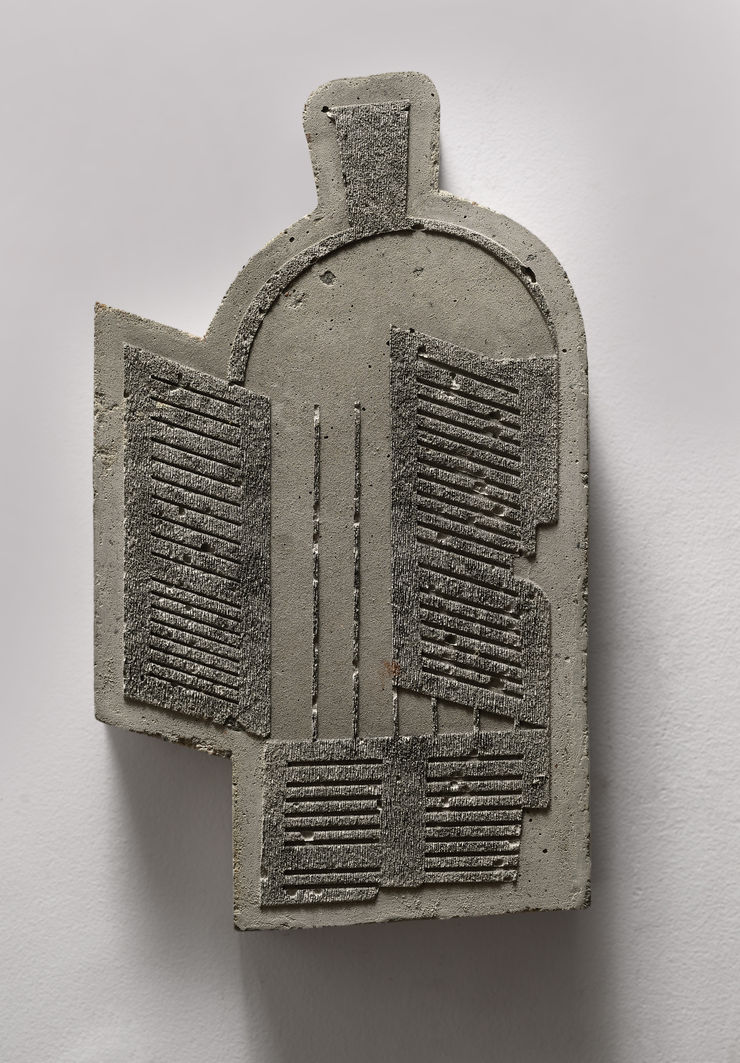
In Diminishing Element, Barman draws attention to the disappearing grandeur of old North Kolkata homes by bringing together carved concrete miniatures of their architectural fragments. These buildings were once adorned with stained glass arches, French louvre windows, mastheads over Doric columns, and intricate motifs on grills, railings, and trellises—many of which have already begun to fade from their structures, perhaps beyond the hope of restoration. Their inhabitants took immense pride in these elements, acquired and crafted with great care and attention to detail, which also denotes the lost glory of the bygone days in their lives. Through these works, Barman renders such architectural details as psychological and material imprints of time, creating an illusion of permanence in the process. He commemorates the emotional connection between the inhabitants and their architecture—the memory of how a space once was, and what it may never be again, much like these fragments themselves, which may never again be held or experienced in their original form.
-
The body of work looks at the outdoor kitchens that are often found in the clusters of shacks scattered amidst the urban landscape of Kolkata. Through relationships with socioeconomically vulnerable communities, Barman has gathered recipes and methods of sustenance that exist largely outside mainstream culinary consciousness. Preparations with jhinge khosa (ridge gourd peel), dumur (fig), phool kopir data (cauliflower stalks), mocha (banana florets), kochur loti (Taro stolon), bok phool (hummingbird tree flowers), chichinga (snake gourd), kochu phool (taro flowers), tita begun (Turkish berry), and shapla (water lily)—ingredients that are conventionally overlooked become the basis of survival for others. Offal, entrails, and the oft-discarded parts of vegetables and plants, which are considered mostly inedible, in fact, carry immense nutritional value. Barman’s work challenges the hierarchies embedded in our understanding of food; of what we consider crucial for dietary sustenance. The kitchen, in this context, is not a private domestic space but rather a communal one, shaped by collective knowledge and shared survival. Kitchen Stories is thus a testament to the resourcefulness of communities who have long known how to nourish themselves by negotiating the deprivations and hardships of their reality.
-
Rathin Barman (b. 1981 in Tripura) lives and works in Kolkata, India.
Rathin Barman | The cage broke, and I found the horizon
Current viewing_room