-
-

-
Chanakya School
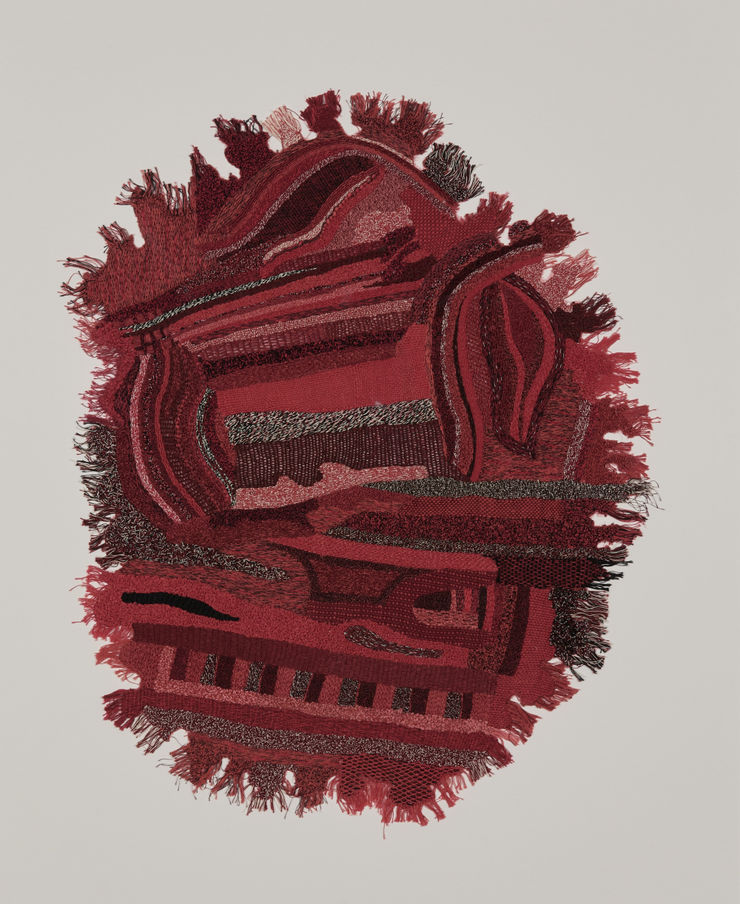
Trace III, IV, V, 2025A large triptych Trace (III-V) anchors the exhibition forming a continuous abstract landscape where the practice dwells in contemplative inquiry, and the textile builds a language that translates gesture and intuition into form. Combining thread and bead, the surfaces emerge through gradual layering, often reaching twelve layers of depth, similar to how traces are built in time, retaining a stone-material quality of landscape, yet embodying the suppleness of thread. Adjacently, singular panels of woven thread (also titled Trace) are on view that further highlight Chanakya School’s immersion in historical practices of weaving, embroidering, spinning, sculpting, and dyeing. Through their process in the making of the textile panels, sculptural forms within them develop, which are guided by an agnostic relationship to material that allows each medium to find its own voice.
-
-
Trace is also primarily grounded in the recognition that women have long carried these lineages. They have encoded their shared histories into the very logic of the weave, preserving truths that spoken language or written records often fail to capture. Fundamentally women-centred in its pedagogy, the Chanakya School works within a wider practice that includes both female and male craft practitioners, creating a body of work that responds to the steady erosion of such practices by tracing a return to elemental acts of remembering and mark-making.
-
The exhibition serves in equal parts as an exploration of interconnected textile histories, also as a repository of understanding residues of the human hand, imprinted in thread over time. Few human inventions carry our imprint across time as intimately as cloth—through cultures and centuries, textile has absorbed the personal alongside the collective, becoming a palimpsest of human experience where stories are deposited, layered, and preserved.
-
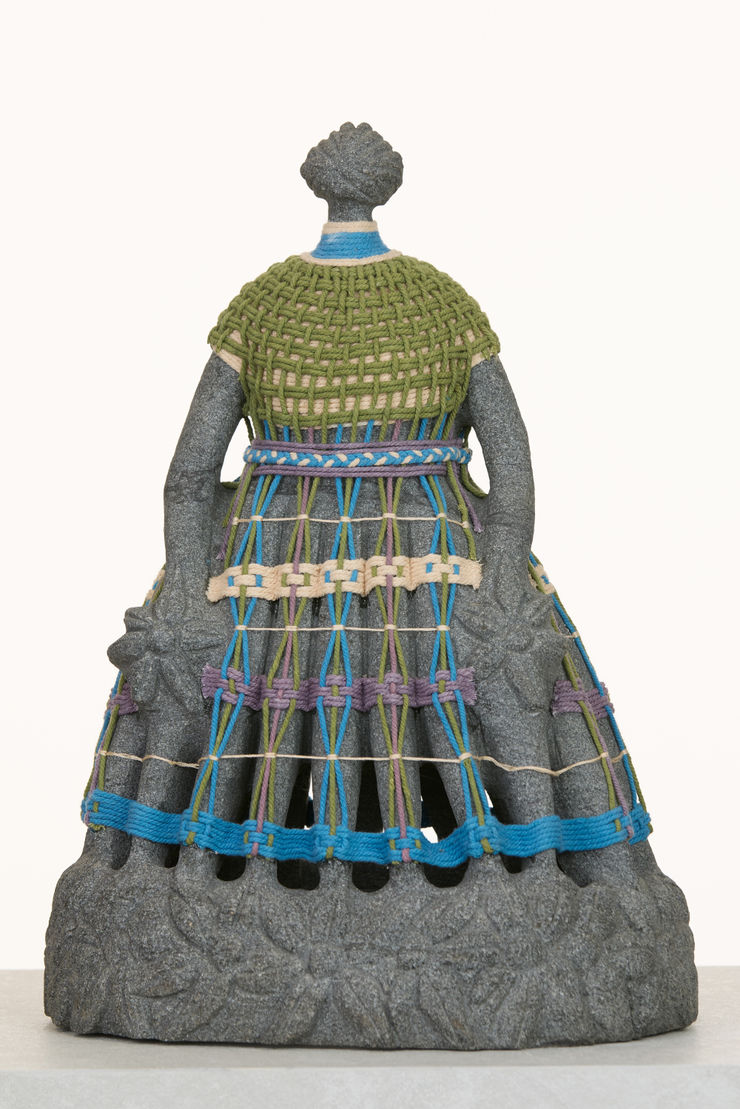
Anthropomorphic forms, referring to earlier stone carvings that serve as portraits. On the textile panels they now appear softer, more fluid and often hold abstracted floral offerings rendered in stone-like grey glass beads. The stone sculptures, titled Form (II-V) which are hand-carved black stone with armatures bound with organic thread, stand as witness and in dialogue with the figures in the panels.
-
A significant thread of the practice foregrounds the unacknowledged role of women in weaving communities—especially preparatory processes like shuttle wrapping. Smaller works isolate and honour these techniques in the body of work titled Flowers in the Night. Woven on Saori looms, the panels draw on herringbone, basket weave, and chevron, among the earliest systems through which fibre was organised into meaning. Using hand-dyed cotton, linen and jute, these structures trace a continuum from early loom technologies to contemporary practice, showing how innovation has always grown from within craft rather than in opposition to it. The surfaces do not hide their fractures; rips, joins, and inconsistencies remain visible.
-
Hand embroidery extends this inquiry in the works, with recycled seed and glass beads stitched using cotton and silk thread through the deliberate process of layering. Woven hanging sculptures Flowers in our Forest, and Sun Within further evoke elemental references of the practice such as the forest, sky and the sun that reveal at times central human portraits, emerging from behind the dense thread.
-
In a large vaulted space at the gallery, natural light filters through an immersive sculptural installation Dwelling that refers to deconstructed “Bhunga” forms. In the Kutch region, bhungas have long been sites of social and cultural exchange.
Here, they are reimagined as standalone forms, resembling women gathered in a domestic setting, weaving in intimate circles that nurture solidarity and inherited wisdom. Using organic thread dyed with madder root, the installation seems to indicate towards the heart of collective authorship at Chanakya School, where the transmission of knowledge is placed firmly in the hands of female artisans, who reframe tradition as an evolving, thinking practice. Ideas of fragmentation, decay and dismantling are also explored in the installation with cords extending outwards like lifelines from the wombs of these bodies towards each other. The installation is surrounded by woven wall panels titled Field Notes, that explore several technical experiments and material juxtapositions. The robustness of these experiments take shape in a hanging tapestry titled Sediment.
-
Trace upholds Chanakya School’s collective practice and underscores their inimitable prowess in textile construction through intricate beadwork, weaving, embroidery and stitching using recycled seed and glass beads, organic thread and cotton, and natural dyes alongside their exploration of form through stone sculptures and installation.
-
-
Chanakya School, Field Notes I, 2025
-
Chanakya School, Field Notes II, 2025
-
Chanakya School, Field Notes III, 2025
-
Chanakya School, Field Notes IV, 2025
-
Chanakya School, Field Notes V, 2025
-
Chanakya School, Field Notes VI, 2025
-
Chanakya School, Field Notes VII, 2025
-
Chanakya School, Field Notes VIII, 2025
-
Chanakya School, Field Notes IX, 2025
-
Chanakya School, Field Notes X, 2025
-
Chanakya School, Field Notes XI, 2025
-
Chanakya School, Field Notes XII, 2025
-
Chanakya School, Field Notes XIII, 2025
-
Chanakya School, Field Notes XIV, 2025
-
-
Trace upholds Chanakya School’s collective practice and underscores their inimitable prowess in textile construction through intricate beadwork, weaving, embroidery and stitching using recycled seed and glass beads, organic thread and cotton, and natural dyes alongside their exploration of form through stone sculptures and installation.
-
At its core, Trace throws light on Chanakya School’s continued exploration of the human condition, of women’s agency, and their decades-long immersion in upholding generational knowledge transmission through textile. Like a trace over time, the works in the exhibition build deeply layered impressions, created weave upon weave, bead upon bead, thread upon thread, and knot upon knot, rooted in the natural world within the arc of life itself.
Founded in 2016, the Chanakya School is a Mumbai-based non-profit institution and artist collective that extends the legacy of Chanakya International, a textile house with a four-decade history in elevating and preserving India's cultural heritage through craft excellence. Under the artistic direction of Karishma Swali—whose thirty years of sustained engagement with craft informs its ethos—education, research, and material exploration are brought into a shared practice.
The school functions as both a site of learning and experimentation, placing women’s practices and intergenerational knowledge at the centre of cultural inquiry. Working across weaving, hand embroidery, lacemaking, stone carving, and ceramics, the school integrates pedagogy with material research through an interdisciplinary approach. Drawing on more than 300 embroidery and weaving traditions, it perpetuates craft as a critical mode of contemporary expression. Since its founding, its school has trained over 1,400 women.
Recent institutional presentations include Indigo: The Sky Below (2025) at the Mobilier National, Paris; En Route (2025) at the Vatican Apostolic Library, Rome; and Cosmic Garden (2024), presented as a Collateral Event of the 60th International Art Exhibition – La Biennale di Venezia (2024).
-
For any further information and press related enquires please write to admin@experimenter.in
Chanakya School | Trace
Current viewing_room