-
-

-
-
Pachpute brings together a new body of morphed sculptures and paintings of the uneasy, unsettled energies buried within difficult social realities. He delves closely into the inner worlds of the characters he has continued to draw over the years, exploring the fire that persists within them.
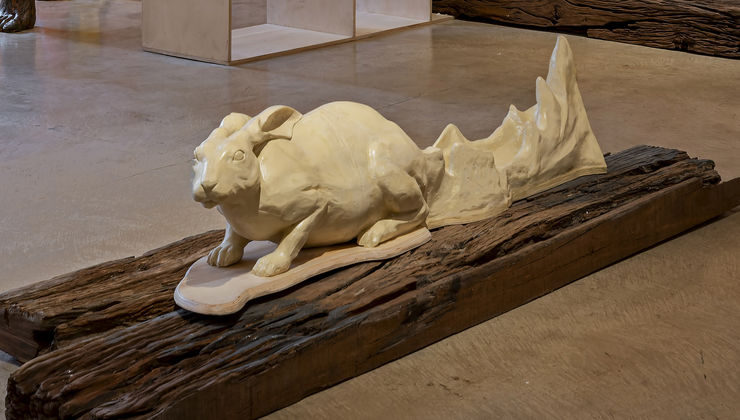
The works reflect on the displacement of forests, wildlife, and ecological systems through mining and industrial expansion. Pachpute examines how altered landscapes force wild animals into villages, farms, and urban peripheries, often leaving them trapped within mining sites or human settlements.They draw from personal memories, particularly a childhood encounter with a sloth bear that entered a neighbouring house and remained trapped there for six to seven hours before being rescued. This experience left behind an enduring impression in Pachpute’s mind. The works also consider the gaze of wild animals—moments of mutual recognition marked by apprehension, suspicion, resistance, and uncertainty. Embedded within this gaze is the reality of human encroachment on territories once belonging to the wild.
The title Crawling Through the Jungle emerges from reflections on coexistence, and the increasing inaccessibility of forests shaped by fire, mining, industry, and settlement. Crawling becomes a metaphor for fear, struggle, and survival. In Crawling Through the Jungle - IV (Sambal Deer), a curtain functions as a metaphorical threshold between the world of humans and that of the wild. It is a barrier that remains present yet appears on the verge of disappearing. In Crawling through the Jungle - V (Sloth bear), windows recall the bear’s confinement, and the standing animal becomes a crucial figure within the work—recalling Pachpute’s memory of the bear rising repeatedly, looking outward, and returning a gaze that was both unsettling and deeply affecting. The house appears as a symbolic element, while references to abandoned mines and polluted water point to the broader environmental transformations that frame these encounters. The bear gradually merges with the architecture that shelters and confines it.
The works reflect on the shifting boundaries between wilderness and human settlement, and on the increasingly complex realities of coexistence in landscapes marked by extraction and displacement.
-
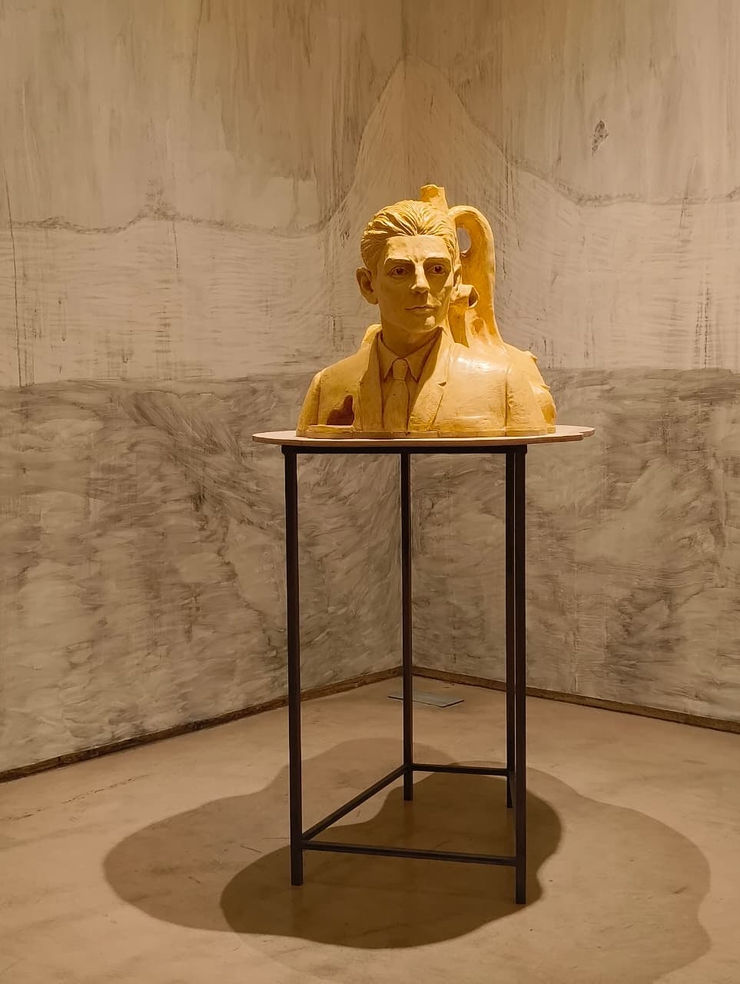
His work captures moments of inner turmoil, emotional collapse, and existential erosion. Echoing the concerns of thinkers and writers who have explored emotional terrains shaped by vulnerability and constraint, Pachpute draws inspiration from George Orwell’s struggle in “Shooting an Elephant” (1936), which was not a confrontation with an enemy but with forces and responsibilities he never anticipated facing. He also alludes to Gregor Samsa, Franz Kafka’s protagonist in The Metamorphosis (1915), who becomes both the cavern he has carved for himself and the one shaped by his surroundings.
-
-
Prabhakar Pachpute, A flame of the forest (A series of an observer), 2023-25
-
Prabhakar Pachpute, A flame of the forest (A series of an observer), 2023-25
-
Prabhakar Pachpute, A flame of the forest (A series of an observer), 2023-25
-
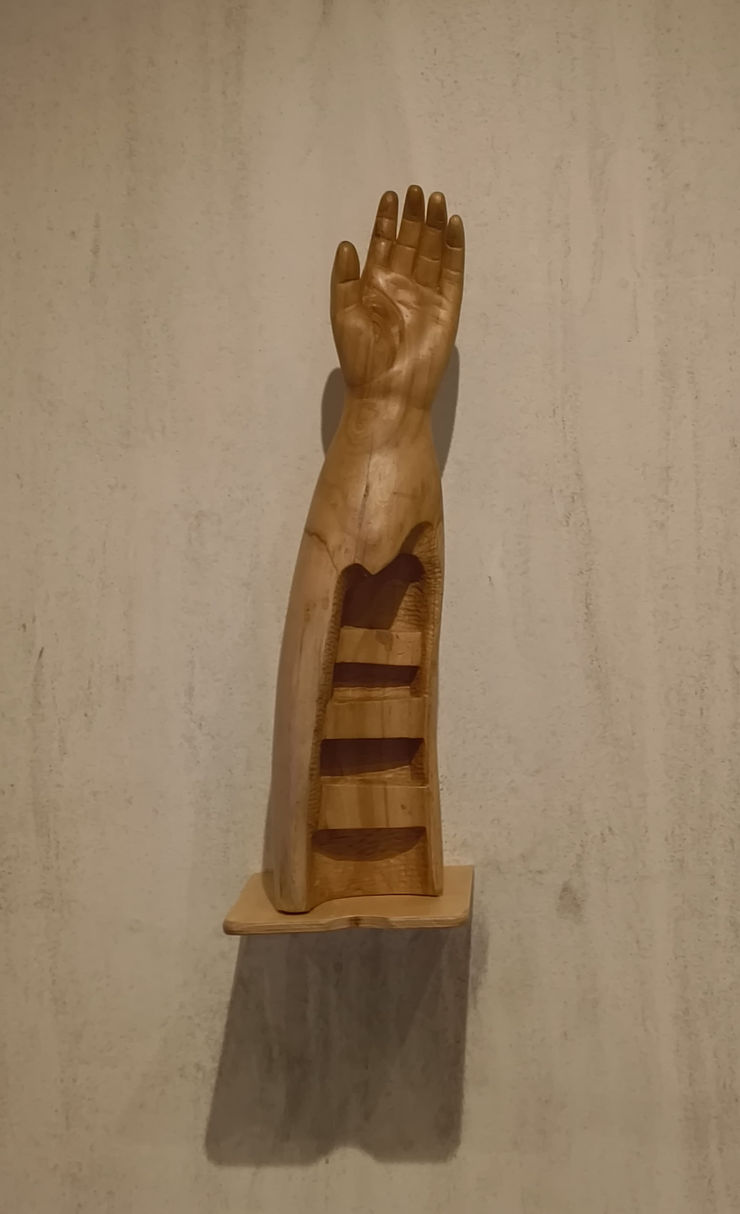
Prabhakar Pachpute, Floating steps, 2024
-
Prabhakar Pachpute, Whispering echoes, 2024
-
Prabhakar Pachpute, Expansion of resistance |, 2023-24
-
Prabhakar Pachpute, Devouring mind (maquette), 2023
-
Prabhakar Pachpute, A flame of the forest (A series of an observer), 2025
-
Prabhakar Pachpute, Found geographies, 2024
-
-
In Pachpute’s Lone Runner’s Laboratory are a series of woodcarvings, titled A flame of the forest (A series of an observer). They draw on indigenous references and are shaped by his visit to Mexico’s National Museum of Anthropology. Resonating with the vertical forms of tree bark set against floods, as well as totemic poles from Africa and North America, these monumental works recall structures that have served multiple purposes within communities and stand today as enduring symbols of resilience. — Excerpt from the essay “Crawling through the Jungle” by Snehal Morey
-
-
Prabhakar Pachpute
Looking at shooting an elephant after Orwell, 2025At the same time, they explore the inner strength that can emerge from these experiences. Deeply intimate and unmistakably solitary, Lone Runner’s Laboratory uncovers a churning tempest at the heart of Pachpute’s quest for answers to a complex set of universal questions that confront us today.
In Lone Runner’s Laboratory, Pachpute continues his engagement with the politics of exploitation, but takes inspiration from thinkers and writers who focus on emotional experiences shaped by vulnerability and constraint within broader social structures. He is profoundly influenced by the renowned writer George Orwell (1903–1950) and responds to his essay “Shooting an Elephant” (1936). In the essay, Orwell recounts his experience as a British colonial police officer in Myanmar, then Burma, exposing the ethical paradox of imperialism, where the performance of power overrides moral agency, compelling him to shoot an elephant he is personally opposed to killing. Cast in jesmonite, Pachpute’s sculpture After shooting an elephant (close observer) traces Orwell’s psychological terrain through cavern-like forms of his introspective inner landscape. Orwell’s ethical quest further unfolds in the monumental painting Looking at shooting an elephant after Orwell, in which Pachpute renders a multi-layered landscape. He exposes the dehumanising mechanisms at work and the tragedy of acting against one’s conscience: fighting on behalf of a crowd unable to recognise that the elephant is no longer an enemy. — Excerpt from the essay “Crawling through the Jungle” by Snehal Morey
Prabhakar Pachpute, Looking at shooting an elephant after Orwell, 2025, Courtesy: Private Collection, New York.
-
-
Prabhakar Pachpute, Museum Menageries 42 (Rest), 2025
-
Prabhakar Pachpute, Museum Menageries 43 (Fractured body), 2025
-
Prabhakar Pachpute, Museum Menageries 44 (The fossil reptile), 2025
-
Prabhakar Pachpute, Museum Menageries 35, 2020
-
Prabhakar Pachpute, Museum Menageries 23, 2020
-
Prabhakar Pachpute, Museum Menageries 33, 2020
-
-
Developed in response to multiple visits to mines, barren landscapes, and mining and agricultural museums, Museum Menageries sees Pachpute delve deeper into, and reflect specifically on, the characters that have shaped his panoramic landscapes over the years. In these works, he revisits the conceptual frameworks and urgent responses from a period when he first began critically examining the impact of mining on both the environment and human lives. Pachpute now examines them as phenomena, approaching from the periphery and maintaining a deliberate distance to better understand the complexities, contradictions, and nuances that shape these lived realities.
For more than a decade, Pachpute has critically examined the impact of mining on both the environment and human lives. What began as a study of altered natural and industrial landscapes has deepened into an exploration of the inner worlds of those most affected. This series of artworks engages with social and psychological dimensions of hardship and systematic abuse.
Pachpute received his BFA in Sculpture from Indira Kala Sangit University, Khairagarh (Chhattisgarh, 2009) and his MFA from Maharaja Sayajirao University of Baroda (Gujarat, 2011).Select solo and group exhibitions include Lone Runner’s Laboratory, Experimenter - Colaba, Mumbai (2026); Folkstone Triennale (2025); Museum of Modern Art Warsaw, Poland (2025); 59th International Art Exhibition of La Biennale di Venezia (2022); Conversations on Tomorrow, Sadie Coles HQ, London (2022); Tate St. Ives (2022); Artes Mundi 9, Cardiff (2021); Kunsthalle Wien, Vienna (2021); Gardens as Thought Form: Lexicons for Revolution, Experimenter - Hindustan Road, Kolkata (2021); Lone Runner’s Laboratory, On | Site, Bikaner House, New Delhi (2021); Beneath the Palpable, Experimenter - Ballygunge Place, Kolkata (2020); 3rd Industrial Art Biennale (2020); Glasgow School of Art (2019); Searching for Stars Amongst the Crescents, Experimenter - Ballygunge Place, Kolkata (2019); Jameel Arts Centre, Dubai (2019); Asilo Via Porpora, Milan (2018); Ruminations on Labour, Experimenter - Ballygunge Place, Kolkata (2018); 4th Kochi-Muziris Biennale (2018); 2nd Yinchuan Biennale (2018); Dhaka Art Summit (2018); STUK, Leuven (2018); AV Festival, Newcastle (2018); Shadows on Arrival, Experimenter - Hindustan Road, Kolkata (2017); Parasite, Hong Kong (2017); Asia Cultural Centre, Gwangju (2017); National Gallery of Modern Art, Mumbai (2016); Immateriality in Residue, Experimenter - Hindustan Road, Kolkata (2015); MACBA, Barcelona (2015); 14th Istanbul Biennial (2015); 8th Asia Pacific Triennial, Brisbane (2015); 31st São Paulo Biennial (2014); 5th Fukuoka Asian Art Triennial (2014); DRAF, London (2014); The Land Eaters, Experimenter - Hindustan Road, Kolkata (2013); Van Abbe Museum, Eindhoven (2013); Kadist Art Foundation, Paris (2013); IFA, Stuttgart & Berlin (2013); Clark House Initiative, Mumbai (2012), among others.
Prabhakar Pachpute | Lone Runner’s Laboratory
Current viewing_room