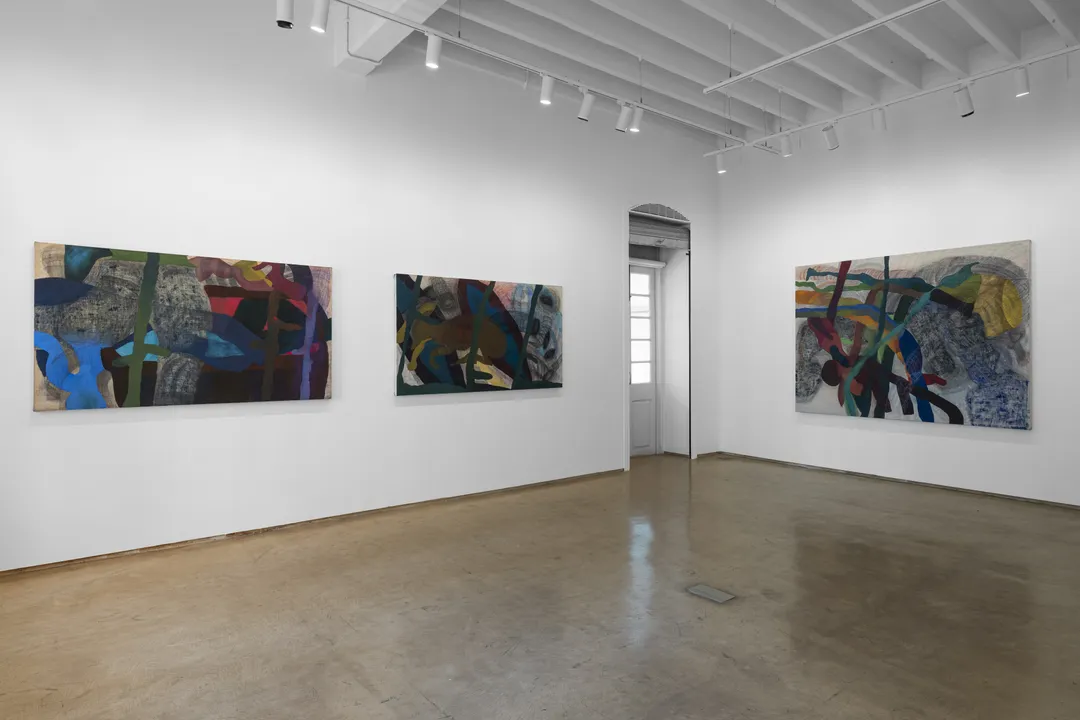
Experimenter presents of fire-harpoons, Kaveri Raina’s debut solo exhibition in India that will bring together a new body of works.
Vital Signs: The shape of Kaveri Raina's abstractionism
Exhibition essay by Upasana Das
In Kaveri Raina’s latest body of work of fire-harpoons at Experimenter – Colaba, Mumbai, a tenuous connection to unresolved discomfort in her past is gorged out through her readings of Ranjit Hoskote’s translations of the poems of 14th century Kashmiri mystic Lal Ded, also called Lalla, often mentioned endearingly before her by her Kashmiri family. Raina had never been to Kashmir, where her father was born and her grandparents lived through political strife. Last year when the volume was mentioned again by her father in passing in reference to his memories of her grandparents’ experiences in Kashmir, she picked it up from her library hoping to form a kinship to another home, which remains a space she has never been to.
Her figures are disembodied and burly, like the late Baroque painter Giulia Lama’s rendition of Saturn devouring his son, where clumps of flesh cloy together to constitute the fleshy ill-fated offspring – compared to Goya’s interpretation with premature musculature. Raina’s creatures, if we can call them that, find themselves stuck in vortexes or emerging from the cavernous depths of her canvas which holds space for time warps, where her past and present blend together to consistently send transmissions as present perfect continuous. It makes one feel part of the dispatch loop due to sheer scale of works as one lies awaiting the combustion, which is a feeling Raina holds on to from being confronted with emptiness after peeping through black holes in Lee Bontecou’s giant space organisms or sitting before the swelling tension in Mark Rothko’s black-on-black paintings.
Although not overtly decipherable, Raina draws an emotive connection to Lalla’s act of walking and her own mark-making with harsh graphite on paper. The poet’s monologic vakhs embed themselves into her slower abstract expressionistic practice, which excavates physical forms generated from internal fixations leading to a “quick satisfaction” immediate drawing practice. She seems to unconsciously think through her material, replicating angry grids akin to the threads in the porous burlap she uses like the postwar work of gestural abstractionist Hans Hartung. These sketches demand space, taking up an entire wall in her New York studio – replicated in her solo at the gallery in Mumbai, each paper a letter in a linearly scrawled line imitating Lalla’s Perso-Arabic script from right to left – where papers conjoin to hold the blackened shape taken by the urgency of her purging.
Raina’s preoccupation with volatile interiority is witnessed here through her resonating with one of Lalla’s vakhs comparing the mind to an ocean which throws up an angry tide of fire-harpoons which stick in the flesh. “But weigh them, and they weigh nothing,” Lalla urges. A dusty gust of wind rears up menacingly in Raina’s frantic sketches – all of them entitled to understand the hidden self. As someone who was overcome with a gnawing sense of anxiety after a deeply unwilling immigration from Delhi to conservative Ohio in the early 2000s – a decision taken by her parents for her, she repeats – learning to be comfortable in her skin took long and shifted with the changing electoral politics in the US. Therefore, putting her mark down in aggressive graphite on equally unforgiving burlap feels political, asserting presence.
Most of the burlap Raina resorts to are made in India and used as the shape-shifting vessel transporting items from the subcontinent to the US – which drew her to making the coarse material lying in her studio with a migratory trajectory, her base. Raina has always had a push-and-pull relationship with her material and medium – where with burlap it’s almost like giving herself away to the material through repeated sweaty gestures of slathering glossy acrylic upon it or ensuring flaky graphite stays on. This discomfort sits and percolates as some of the burlap remains uncoloured like disintegrating pixels constituting an image and she doesn’t make it easy for us to view the work either, upon which sits a disorienting sheen of oil sticks and graphite.
As for medium, a mid-century generation of colour field painters like Rothko and Morris Louis propelled her towards colour field which she navigated through natural dyes in her mother’s kitchen like turmeric, red chilli powder, and fennel. In a portrait of her studio that’s more than a decade old, turmeric lies everywhere on the ground with strips of fabric dyed a bright yellow hanging in a corner like curtains.
Moving away from figuration, it was with them that she’d initially enter into a discourse on form and colour within her work, abstracting fickle persuasions and prolonged hauntings through a patchwork of lines and cut-outs like in Robert Rauschenberg’s collages. Whereas now they collage as emerging creatures and figurations on burlap, rejecting her early fascination with geometry.
It feels atypical to see Raina’s bright acrylic stand out amidst a web of graphite scratchings working their way towards the shadowy and illegible. As if the artist herself had made an effort to dim their brightness. Despite them, solid blocks of colour peek through, taking from the graphic oils and woodcuts of painter and printmaker Roger Brown who was part of the Chicago imagists associated with the School of the Art Institute of Chicago – whose work she’d encountered during her Master’s programme at the School, where she was also archiving Brown’s work. His monochrome geometric shapes making up a mellow landscape or repetitive squares atop each other forming the modern lit-up flat windows full of activity – immediately making us feel like a voyeur – find their way into clunking and puffing, back to the loose clouds (2025) where vacant blue windows collapse – as if picked up from the childhood fable of the three pigs and bad wolf who huffed their house down – over a coffin, upon which rests a solitary ant.
They become the ultimate undertakers of Raina’s coffins which recall Chicago painter Leon Golub’s figurative acts of brutality in thick dabs of paint so typical of the graphic imagists, where a perpetrator looks back as if daring us to react after he pulls a gun on a defeated figure already in the casket. In Raina’s works these capitalist boxes of eternal rest become sentient spaces for the undead and the un-buried to portal through and about, refusing to lie still. Like Golub, her works sometimes sits in the pregnant pause after these acts of combustion like in her exhibition at PATRON, Chicago, songs of silence, yet bluebirds hum (2023) where focused white lights around the claustrophobic apertures mimic torchlights of inquiry at a crime scene or a medical operation – digging and searching. What is Raina consistently looking for?
A cobalt-blue canine springs upon a bowed down figure in the split second before its teeth set in their flesh. In her temporary Kolkata studio a few months before the exhibition opened, Raina recalled her fear of dogs which are apparently more ferocious in Delhi streets. Honing into these feelings of discomfort the artist returns to a seemingly amateur idiom of scrawling to decipher a language to express herself through the shapes which eventually emerge, forming an archive of image archetypes full of tension - that she keeps returning to. The ant emerging in her early works metamorphosises into a different being in the kingdom, the cave, the beginning; and the ant taking over (2024) where its ribcage-exoskeleton recalls the cloying physicality of imagist Christina Ramberg’s corset – powerful in its pink regalia signalling parabolic power.
Jagged shapes pierce through bulbous exoskeletons in her sketches through sheer force. Stitch-like marks perforate and hold together plump shapes in peel away residual tellings (2025) as much as actual threads conjoin two pieces of burlap of varying lengths to make up her large canvas works, which seem to ebb and flow in the the gallery, when juxtaposed with tightly constrained small works in the same room. Objects of injury originally appeared in Raina’s burlap as a simple Philip’s head which poked around sharply in how unattainable yet glorious they are in their heft (2022), as the artist paused her conversation with male artists and started a conversation with female artists like Miriam Cahn and significantly, the artist Lee Lozano – who simultaneously chafed against systemic masculinist structures she had to work within during white picket fence ‘60s where she also once told a gallerist that she saw creativity as male, before leaving the art world and any contact with women altogether – after looking at her series of swift sketches and monumental oils of heavy, girthy tools repulsively swollen in their masculinity. Listening to the news in India at the time, Kaveri veered towards her own studio picking tools she’d use herself like a Philips head, which turned into a weapon of violent sexual transgression.
Others become her companion tools in their propensity to stir unease, even within herself. A thick slinky-like tool awaits in the darkness in splashes like water, ripples from light to dark (2025) for launch alongside a cluster of grenades, heavy in the weight they carry. The open-weave burlap is a laceration with acrylic pushed from behind the work like the unconscious spilling to the fore, dirtying the canvas leaving “disgusting” stains in its wake as the paint dries and the burlap mottles into a hairy scab – some raised like visceral wounds, like in Somnath Hore’s Wound series (1977) where the Bengal artist slashed into clay with hot knives to create moulds for his pulp – which emerged as scarred and bruised prints on paper.
Raina’s burlaps are a live network of nerve endings and communication channels itching to send transmissions. In her sketches Raina steps into Bontecou’s shoes and breaks them apart like an architect to reveal their internal machinery, as much as she attempts towards her own mind. It’s this curiosity which propels her towards the underground and the subterranean in works like lurking over the Field of Emptiness (2025) where she lurks over riverine networks – fluid portals themselves where objects and communications transmit – through the figure of a mermaid-fisherman, a wispy nerve ending himself. Lights glimmering in the distance in past, present, tomorrow tools series 3 – spanning through watery terrains – Raina is constantly searching and listening.
Upasana Das is an arts and culture writer. She has previously written for ArtReview, The Guardian, British Journal of Photography, BOMB, Elephant Art, ASAP | art, The New York Times, Dazed, Vogue India among others.
Kaveri Raina (b.1990; New Delhi, India) lives and works in New York, USA. Raina received her MFA from the School of the Art Institute of Chicago, IL (2016) and her BFA from Maryland Institute College of Art, Baltimore, MD (2011).
Select solo and group exhibitions include reflection as a witness, Casey Kaplan, New York, NY (2024); songs of silence, yet bluebirds hum, PATRON, New York (2023); A soft place to land, MOCA Cleveland, OH (2023); Kaveri Raina and Coral Saucedo Lomelí: What Do You Remember About the Earth, Lighthouse Works, Fishers Island, NY (2023); A Space for Monsters, Twelve Gates Arts, Philadelphia, PA (2021); E/MERGE: Art of the Indian Diaspora, National Indo-American Museum, Lombard, IL (2021); and She Persists: A Century of Women Artists in New York, Gracie Mansion, New York, NY (2019), among others.
